What Should My Kids Study in the Age of AI?


Felipe Guerrero
SQA Warrior


The short answer: almost any career is still worth studying, as long as artificial intelligence is one of its pillars and your kids never stop analyzing on their own. AI does not kill careers. It kills careers that refuse to evolve.
Parents, friends, siblings and relatives keep asking me the same question: "What should I put my kids to study now that AI solves almost everything?" Programming used to be the safe bet. Today you can build software by writing what you want in plain human language. So the question is fair.
The worry is real, too. A survey released this week by HelloCollege found that 66% of college students are more concerned about their future career because of AI, and 37% are already shifting their career plans around it. At SQAWarrior we have spent 17 years watching technology reshape careers, and we believe the answer is not fear. It is choosing well.
First, where are we with AI?
Before choosing a career, we need to agree on where AI stands today. Not everybody sees the same picture. In my conversations I find five levels of understanding:
AI is a chat: A virtual assistant that helps with the daily, repetitive tasks you do every day.
AI transforms my company: It becomes a tool for the digital transformation of my business.
AI builds products: People at this level know AI is already being used to develop projects that can be sold.
AI builds AI: Some teams are already producing AI with AI itself.
AI could rule us: The deepest level asks a different question: not how AI serves humans, but how
humans could end up serving AI if we lose our knowledge and stop thinking for ourselves.
Where you are on this ladder changes how you answer the question about your kids. If you think AI is just a chat, you will underestimate the change. If you only see level 5, you will freeze. The useful view is in the middle: AI is a massive tool, and the people who keep thinking are the ones who drive it.
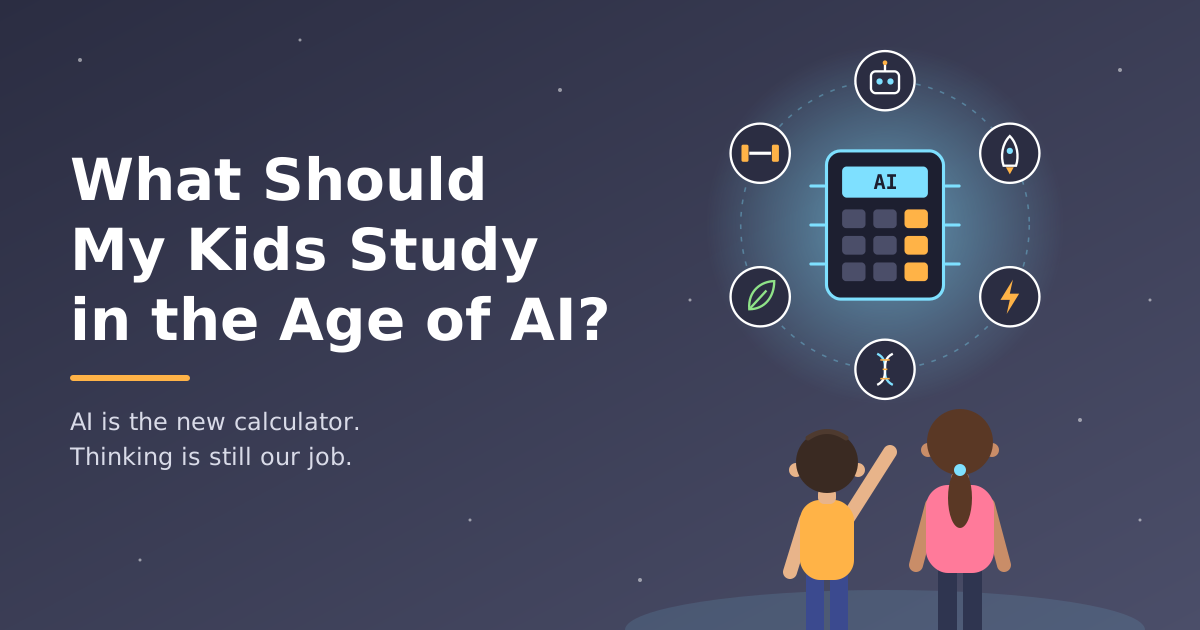
AI is the new calculator
Think about the calculator. Long ago, people solved very complex operations in their heads, because there was no calculator and tools like the abacus were slow. When calculators arrived, many of us lost the habit of multiplying, dividing, adding and subtracting mentally. It was simply easier to type the numbers.
The calculator did not make us dumber, it moved our focus. A shop owner who has a calculator next to the register knows the right change instantly, instead of trusting a tired mind. That freed time went into selling more, developing products faster and knowing costs right away.
AI is the new calculator of the human being. Part of our brain will no longer be used for the common operations we did before. So the real question is not "what will AI do for me?" but "what will I do with the time and capacity AI gives back to me?"
That is exactly the question your kids' education must answer.
The beauty is in the procedure, not in the answer
This month the math world got shaken. According to AFP, OpenAI released solutions to 719 previously unsolved problems last week, some of them open for decades. Fields Medal winner Hugo Duminil-Copin told colleagues that all his avenues of research were now gone.
But listen to what many mathematicians are really worried about. It is not only their jobs. It is that the beauty of mathematics was never the solution, it was the procedure: the analysis, the dead ends, the reasoning that turns one answer into knowledge others can build on.
That is why our teachers always asked us how we got the result, and graded the procedure more than the final number. Today I watch how my niece's homework is graded. Everything goes through AI, the answer comes out, and that's it. The student does not analyze how the answer was reached, because it no longer matters to them.
This is the one thing we cannot lose: ANALYSIS. Humans must keep analyzing and keep proposing. The moment we stop, AI will be the one governing us. Maybe we are close to that point, but that is the worst-case scenario, not the only one. There are still many people who love to study, to analyze and to propose. That is why there is a viable future.
A simple rule for parents: if your kid cannot explain what the AI did and why, they did not learn. They copied.
Imagine your kids 20 years from now
To choose a career, ask yourself what the world will look like in 20 years. Many people answer: "I don't know, there's too much uncertainty." But humans have always imagined their future. In 1865, Jules Verne wrote From the Earth to the Moon, when going to the Moon was unthinkable. He imagined it and put it in a book.
We have it easier: there are thousands of movies and series showing possible futures. Let's use them as a career map.
The worst future - Terminator - Skynet takes over the Earth and wipes everything out. It could happen. But for that to happen, there had to be robots. And for robots, there had to be robotics engineers. There's our first career.
The explorer future - Lost in Space - A family travels to other planets. A 13-year-old boy can program a robot. His sister specializes in medicine, but uses far more sophisticated instruments to evaluate, diagnose and fix medical problems. Everybody knows how to pilot the ships. There we see medicine with advanced technology, programming as a basic skill, and aeronautical engineering
The mixed future - Altered Carbon - The Netflix series shows cloning, AI, robotics and war, but also a good life for many. There we see biotechnology at full speed.
All these realities are possible, depending on how we picture ourselves in them. We don't know exactly what reality will be, but we do know where we are heading. Flying cars already exist. People panic and say the world is ending. No. We are also explorers: the deep sea and outer space are still largely unexplored. That's where we're going.
Careers the AI future will need
Most current careers will not disappear, they will specialize. A new McKinsey Global Institute report estimates that AI and automation will cut demand for about 36 million U.S. jobs by 2035, while growth elsewhere creates about 41 million. The jobs will exist. The challenge is being prepared to move into them.
Follow the chain: AI needs robots, robots need components, components need materials, and everything needs energy. Here is where I see the opportunities:


Will some careers end? Of course. The people who swept shopping malls are being replaced by machines. Eventually, robotics and AI will even assemble and maintain themselves, and they are starting to. But they will still need someone to supply their energy and to decide where they help us in daily life. That is our job.
And don't forget the human side. Gyms, protein brands, fitness, wellness and everything around them are already booming, and this will not fade with AI, it will grow exponentially. The more technology runs our days, the more people look for health, calm and spiritual peace. Careers like sports science, nutrition, physical therapy and psychology will be part of that wave.
So, what should they study?
Any career, as long as it is well grounded and AI is one of its pillars. Not to become an AI expert, but to stay competitive in this world. Every career needs a new foundation, the same way math and language have always been foundations. Today, AI is one of them.
The hard part is not the career, it's the institution. Many people are not applying to universities anymore, and the reason is often not laziness. They find the same outdated curriculum that proposes nothing new. So they choose diplomas, courses and certifications that hand them working tools from day one. The numbers show the urgency: an IMF report on Asia found nearly a 10% drop in employer demand for the occupations most exposed to AI.
When you evaluate a university, a course or a bootcamp for your kids, ask three questions:
Is AI part of the core curriculum? Not an elective, a foundation inside every subject.
Do they grade the procedure, or only the answer? If AI can pass the course alone, your kid is not learning to think.
Do students build real things with real tools?Projects, labs and practice, not only theory from ten years ago.
A good exercise: take the curriculum of the program your kid likes and ask an AI to tell you which subjects it could already do by itself. What's left is what really trains your kid's mind.
Conclusion: We are living the Transistor moment
Remember the transistor, When it was invented, humanity took a huge leap into its next technological revolution: computers, phones, the internet and everything that came after. AI is doing the same thing right now. We are about to take another leap.
The future looks good for everyone, but we have to know what to choose and which institution is at the forefront. Those who are not prepared will probably not find work, or will have to settle for whatever the market offers. Those who are prepared will have countless possibilities, because there is still a whole universe to discover.
So don't ask only "which career?". Ask "will my kid keep thinking, analyzing and proposing, with AI as their calculator?" If the answer is yes, almost any path will work.
Are you a parent facing this decision right now? At SQAWarrior we want to hear your story: tell us what your kids are choosing and what worries you most.
Need help training your team in AI? Contact us. We've been mentoring engineers and teams on software strategy for 17 years.
Sources
HelloCollege 2026 College Student AI Survey (PR Newswire, Oct 21, 2026)
Mathematicians fret as AI solves the unsolvable (Bangkok Post, Oct 20, 2026)
AI Just Wrote 700+ Math Papers. Will It Replace Researchers? (Rising Researcher Academy)
McKinsey: AI will create more jobs than it kills (Fortune, Oct 3, 2026)
IMF report on AI jobs in Asia (Global Education News, Oct 20, 2026)